Your team is the integration between systems that do not talk to each other.
The same data gets typed into your CRM, your finance package and your ecommerce platform by hand, because none of them connect. It is slow, it causes errors and it does not scale. We join your systems up so the data moves on its own.
Our workflow mapping follows one real job through your systems and shows where your data gets stuck, where it will not scale and where the risk sits. No obligation.







You do not have an integration problem on paper. You have it in your team's day:
- Double typing the same order or customer details entered into two or three systems.
- Month-end reconciliation finance rebuilds numbers by hand from exports.
- Stale data nobody trusts the figures because the systems disagree.
- Growth adds admin each new customer, channel or market means more manual handovers.
- Workarounds on workarounds spreadsheets and copied exports holding the process together.
- A key person who knows how it all fits lose them and the process breaks.
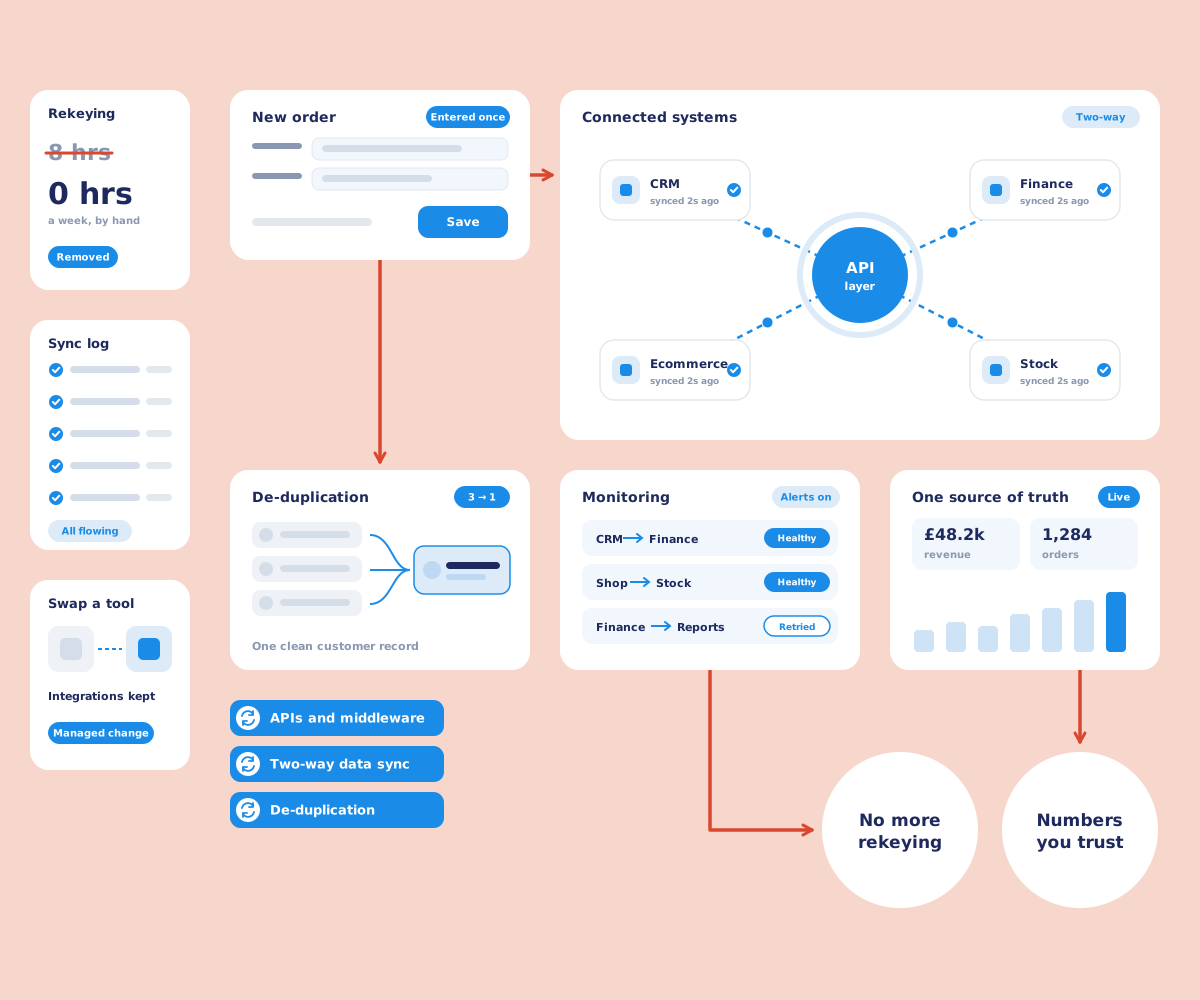
When two tools do not connect, we build the link.
Many tools have a ready-made connector and we use it. Where there is none, we build the API link between them, or open up your own system's API so other tools can use it. Either way the data moves on its own and your team stops being the integration.
- Connect: system and data integration across CRM, finance, ecommerce, operations and more.
- Automate: workflows that move data on a trigger, so no one copies it.
- One source of truth: reliable, reconciled data, so reports can be trusted.
- Middleware and APIs: a layer that lets new tools be added without reworking the rest.
Systems that stopped depending on people to join them up.
Expansion into new markets without reworking core systems.
Expanding into new markets required reworking systems and integrations each time.

Accounting exceptions from manual input down by more than 80%.
Finance teams had to reconcile on-chain events manually, causing errors and slow audits.

A plant hire provider moved from reactive to predictive maintenance.
Equipment issues were only discovered after failure, causing delays and costly downtime.

Connect the two systems that hurt most first, then integrate the wider stack.
Either way we scope it before we build.
Pilot
Connect two key systems
Fixed scope · Low risk
For proving the value by connecting the two systems whose disconnect costs you the most.
- Mapping the data flow
- Build and testing
- Handover and documentation
- Success measured on rekeying removed
The outcome: two systems in sync, and the manual handover between them gone.
Project
Integrate the stack
End to end · Monitored · Maintained
For connecting the wider toolset into one joined-up flow, once the pilot has proven it.
- Full systems and data audit
- Multiple integrations across the stack
- Cleaning and a single source of truth
- Monitoring and alerts
- Ongoing support as you add or change tools
The outcome: a business that runs as one connected system, not a pile of islands.
Start with where the data really goes.
In a business with legacy systems, nobody can say exactly where data goes, or why a workaround was put in. We make that visible first. Then we improve the flow, systemise it and connect it. AI is one tool in the kit, used where it improves the outcome, and only with a clear strategy for it.
Step 1
See it
How one real job moves from system to system and person to person. This is the free Business Process Map.
Step 2
Lean and improve it
Remove duplicate entry and workarounds that no longer earn their place.
Step 3
Systemise it
One agreed route for each type of data.
Step 4
Automate it
Integrations carry the data, so nobody retypes it.
Step 5
Add AI where it pays
Reading documents or flagging exceptions, once the flow is clear.
Our Process
No big-bang integration. We map it, connect the two systems that hurt most, then extend.
- Map A free Business Process Map of one real job, showing where the manual handovers between systems cost you.
- Scope We pick the two systems that hurt most and scope a pilot connection.
- Prove We build and test it, with a rollback plan, so you see the saving on real data.
- Scale With it proven, we extend the integration across the rest of your stack.
Your options, honestly compared.
Questions, answered.
The questions businesses ask before integrating their systems, answered honestly.
Do we need to replace our systems?
Usually not. We connect what you have, and only suggest replacing a system when it cannot be connected sensibly or is itself the problem. The Business Process Map shows how your systems fit together today, so any recommendation to replace something is based on evidence.
Is our data safe during integration?
We handle and move your data securely, clean it as we go and test thoroughly before anything goes live. Nothing is switched on without your sign-off, and we agree what moves where in advance.
What if one of our tools has no API?
We tell you early and propose another route, such as a scheduled export, a file-based exchange or a different tool for that step. Many legacy and niche systems have a workable path, and the map identifies which ones do before you commit to a build.
Can you work with our ERP?
Often, yes. We map the data first and tell you what is realistic, including which flows are worth connecting and which are not. A full ERP replacement across several departments is a different conversation, and we would route that to the AI Discovery Day.
How much and where do we start?
Start with a free Business Process Map and a pilot connecting the two systems that hurt most, so the spend matches the value you see. The wider integration is scoped from there, once the pilot has proven the saving on your real data.
We will be in touch within 24 hours.