Find out what AI is actually worth to your business, department by department.
The AI Discovery Day is a one-day AI readiness assessment. We spend a day inside your business following the job, the order or the deal from first enquiry to final invoice. Within a week you get back around ten opportunities, each with a business case, and a straight answer on where you sit today.
£5,000, redeemable in full against any business case you take forward.
Everyone is told to adopt AI.
Almost nobody is told where it pays.
You have been pitched tools, copilots and pilots. What you have not been handed is a number. Which process, what it costs you today, what it would cost to fix, and what comes back. Until that exists, AI is a line in the budget you cannot defend to a board.
- Tools arrive without a business case attached
- Pilots run, then stall before they scale
- The board wants a payback, not another demo
Every opportunity we find pays on one side or the other.
A business case that only saves hours is a business case your board has heard before. We sort every opportunity by which of the two numbers it moves, because they are bought differently and the second one is the larger prize.


One day in your business.
We start by agreeing what we are there to do, give the room a shared way of spotting an opportunity, then walk your departments and write each case up where the work happens.
We arrive already knowing your business
We read what you already have: your systems list, your org chart, last year's numbers, and anything each department wants to put forward. The day starts from something, not from nothing.
We say what the day is for, and what it is not
Your leader opens with four aims: a shared way of spotting an opportunity, every idea placed in sequence, a business case for each, and three to start with. Then the part that matters: today does not choose tools, agree budgets or commit anyone to a project.

A shared way of seeing it
A short session for the whole group. How to tell a good AI idea from a hopeful one, and the six stages every business climbs, each standing on the one beneath. Your own ideas are placed on the stages, so everyone can see what has to exist first.
We follow the work, not the org chart
We come to the people who do the work, at their own desks. Sales, operations, finance, service. We follow one thing the whole way through, the job, the order, the deal, the service call, and record every place it stalls, doubles up or leaves the system.
Each case is written where the work happens
One person from each team writes up each opportunity on a single card as we talk: what triggers it, how often, what failure costs, and who owns it. Nothing is reconstructed from memory afterwards, and nobody answers the same question twice.

The board, the three, and a number for the board
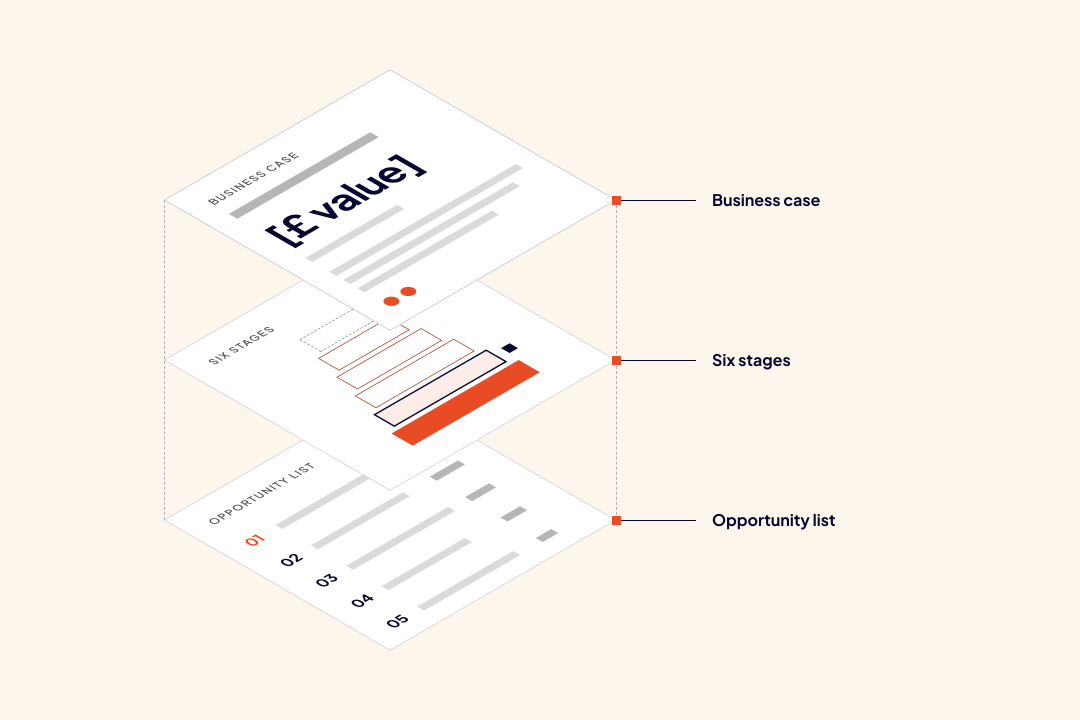
Before we close, every case goes on one board in stage order, and your leader chooses three to start, because of where they sit in the sequence, not because they were the loudest. Within a week you receive the written report: the opportunity list, a business case for each, and your position on the six stages.
*Your team keeps working. We walk alongside them and capture as we go, so nobody is pulled off the floor for a workshop.

Experienced operators, wearing the fastest capture kit on the market.

The people we send have run operations themselves, so they spot a broken process while standing in front of it. They walk your floor wearing Even Realities G2 lenses, which have no camera and capture only the conversation.
The map, the sequence diagrams and the systems list are drafted before we leave the building. You answer each question once.
- Senior operators, not a graduate team taking notes
- Even Realities G2 lenses, streaming to a live analysis session
- The analysis that used to take a team of six takes one person

We follow the thing that actually moves.
Every business has one object that travels through it. A job. An order. A deal. A service call. It starts somewhere, touches eight systems, and stops in at least three places nobody has measured. That object is what we follow, because it crosses every department and exposes every gap on the way.
- Where it starts, and who touches it first
- Every system it passes through, and what each one can and cannot do
- Where it stalls, doubles up, or leaves the system entirely
Six stages of AI adoption, and every one of them stands on the stage beneath.
What lands on your desk within a week.

The opportunity list
Around ten, named by department, each one marked earnings or multiple.

A business case for each
What it costs to build, what it returns, how long it takes.

Your position on the six stages
Where you are, evidenced, not guessed.
The route to stage one
The specific work that unlocks everything above it.
Written so you can take it into a board meeting without rewriting it first.
What happens when the mapping comes first.
10× growth supported
Manual tools and legacy processes couldn’t keep up with rapid business growth.
40× quoting capacity
Manually uploading leasing offers slowed operations and delayed pricing updates.

£100M+ processed
Customers couldn’t view finance options across lenders without manual intervention.




Frequently Asked Questions
The questions directors ask us before they book the day.
Do the glasses record video of our site?
No. The Even Realities G2 lenses our team wear have no camera, so nothing on your site is filmed or photographed. What they capture is the conversation.
Is there a call before the day?
Yes. Book a call with Kash, tell us roughly how you're set up and which departments you want walked, and he'll talk you through how the day would run. Nothing is paid until you both agree the day goes ahead.
How much of our team's time does the day take?
One day. Before it, we read what you already have: your systems list, your org chart, last year's numbers. On the day, your leader opens with what the day is for, the whole group gets a shared way of seeing it, then we walk the floor department by department. Each case is written up where the work happens, so nobody answers the same question twice.
What do we get back, and when?
Within a week: around ten opportunities named by department, each marked earnings or multiple; a business case for each, covering what it costs to build, what it returns and how long it takes; your position on the six stages; and the route to stage one. Written so you can take it into a board meeting without rewriting it first.
What does the day cost, and do we have to take anything forward?
The day costs £5,000. You pick the business cases worth doing, and if you take any of them forward, the whole £5,000 comes off the first one. You are paying for the thinking, and only if you decide none of it is worth doing.
We will be in touch within 24 hours.